

 Current position > News detail
『Annubar Flow Meter Installation Requirements: Straight Run Geometry Rules』Related information(flow rotameter|digital flow meter|balo meter|hydraulic flow meter|volumetric meter|positive displacement meter|pitot tube flow meter|displacement meter|cfm meter|variable area flow meter|inline flow meter|differential pressure flow meter|calibrated flow meter|velocity meter|paddle wheel flow meter|oval gear flow meter|anemometer hvac|multiphase flow meter|doppler flow meter|thorpe tube flowmeter|heat flow meter)

Annubar Flow Meter Installation Requirements: Straight Run Geometry Rules
Quick Answer: An Annubar flow meter needs a straight pipe run of 20D to 40D upstream and 5D downstream in most installations. The exact upstream distance depends on the fitting before the meter, such as a single elbow, two elbows in different planes, a control valve, or a pump. If your pipe layout is tight, send the pipe size and the upstream fitting type to Silver Automation Instruments for a specific straight run calculation.
Why Straight Run Geometry Matters for Annubar Flow Meters
Annubar flow meters are insertion differential pressure devices. The sensor has multiple sensing holes across the pipe diameter. These holes average the velocity profile. This method works well when the velocity profile is stable and symmetric.
Pipe fittings disturb the velocity profile. An elbow creates swirl. A partly open gate valve creates a jet. A pump discharge creates turbulence and an uneven profile. Straight pipe allows the flow to settle before it reaches the sensor. Without enough straight run, the reading can shift. In practice, a 2 percent to 5 percent error is common in short straight run installations.
Last year a water treatment plant in Vietnam sent us a site photo. The Annubar meter had only 6D of straight run after a gate valve. The flow reading at low load drifted by 2.3 percent. Most engineers skip this part until a batch total does not match a tank level.
Recommended Upstream Straight Run for Common Pipe Fittings
Silver Automation Instruments recommends the following minimum upstream straight lengths for Annubar type averaging pitot tube flow meters. The distances are expressed as pipe inside diameters, written as D.
Single 90 degree elbow: install at least 20D upstream and 5D downstream.
Two 90 degree elbows in the same plane: use 25D upstream and 5D downstream.
Two 90 degree elbows in different planes: use 40D upstream and 5D downstream. This is the worst common case. Swirl from different plane elbows persists longer than most engineers expect.
Control valve or regulating valve: use 30D upstream and 5D downstream. A control valve creates a high velocity core. If the valve is only 10 percent open, the velocity profile can be heavily distorted.
Pipe reducer or expander: use 15D upstream and 5D downstream.
Pump discharge or compressor discharge: use 30D upstream and 5D downstream. Pulsation can also affect the differential pressure signal, so a dampened transmitter helps.
Downstream Straight Run Rules
The downstream straight run is usually 5D for Annubar flow meters. The meter itself creates a small pressure disturbance. Downstream fittings too close can create back pressure instability. This is less critical than upstream swirl but still matters for high accuracy.
In tight pipe racks, some engineers use 3D downstream. That can work for non critical flow indication. For custody transfer, batch charging, or steam mass balance, keep the 5D downstream rule.
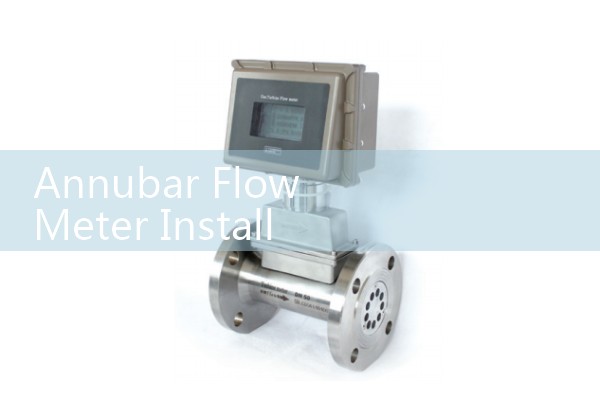
Annubar flow meters are used from DN50 to DN1800 in gas, liquid, and steam lines. The straight run requirement is based on the actual internal diameter D. For example, a DN150 Schedule 40 pipe has an internal diameter of 154.1 mm. If the meter needs 20D, that is 3.08 meters of straight pipe upstream.
Always calculate the straight run in meters, not in pipe fittings alone. A DN150 pipe with 2 meters of straight run may not be enough after a reducing elbow.
Fast Installation Check for Field Engineers
Before you weld a fitting or cut a pipe, check the upstream fitting. Find the pipe inside diameter. Multiply the required D value by the actual pipe ID. Mark the location. Then check if the downstream section has at least 5D before the next valve or elbow.
Do not install an Annubar meter directly after a partially open gate valve. Do not install the meter in a vertical downflow liquid line if the pipe is not fully flooded. These two field mistakes cause more errors than the straight run calculation itself.
How to Get a Straight Run Calculation or Quote
Silver Automation Instruments supplies Annubar type averaging pitot tube flow meters for gas, steam, liquid, and condensate lines in Southeast Asia, Oceania, the Middle East, Africa, and Latin America. For a DN150 steam line at 12 bar and 190 °C, we often recommend an Annubar sensor with a 4 to 20 mA HART differential pressure transmitter and a three valve manifold.
Send us your pipe size (DN), pipe schedule, fluid type, pressure (bar), temperature (°C), flow range, and upstream fitting type. We will confirm the required straight run for your Annubar flow meter model and send a price quote.
Tel: +86-25-68650347
Whatsapp: +86-25-52155837
WeChat: +86 15365082610
FAQ: Annubar Flow Meter Straight Run Geometry Rules
What is the minimum straight run for an Annubar flow meter after a single elbow?
Use 20D upstream and 5D downstream. A DN100 pipe with an internal diameter of 102.3 mm needs 2.05 meters of straight pipe before the meter.
Can I install an Annubar flow meter after a control valve?
Yes, but keep 30D upstream and 5D downstream. If the control valve runs at a low opening, add more straight run or install a flow conditioner.
What happens if the straight run is too short?
The flow reading can shift by 2 percent to 5 percent. In steam or gas systems, the error may be higher because density compensation depends on a stable pressure and velocity profile.
Does the straight run length change with pipe size?
Yes, it changes in absolute meters. The required D value stays the same, but the actual length is D multiplied by the pipe internal diameter.
What information do I need to send for a price quote?
Send pipe size (DN), pipe schedule or wall thickness, fluid type, pressure (bar), temperature (°C), flow range, and the upstream pipe fitting type.