

『1.6 L/h flow meter』Related information(flow rotameter|digital flow meter|balo meter|hydraulic flow meter|volumetric meter|positive displacement meter|pitot tube flow meter|displacement meter|cfm meter|variable area flow meter|inline flow meter|differential pressure flow meter|calibrated flow meter|velocity meter|paddle wheel flow meter|oval gear flow meter|anemometer hvac|multiphase flow meter|doppler flow meter|thorpe tube flowmeter|heat flow meter)
 Here is a detailed article about the **1.6 L/h flow meter**, covering its applications, principles, and importance.
---
### The Precision of Low Flow: Understanding the 1.6 L/h Flow Meter
In the world of industrial instrumentation and fluid management, flow meters are indispensable tools. They measure the rate at which a liquid or gas passes through a pipe or system. While many people are familiar with large-scale water meters measuring thousands of liters per hour, there is a critical niche for ultra-low flow devices. The **1.6 L/h flow meter** is a perfect example of this specialized technology. To put this into perspective, 1.6 liters per hour is roughly equivalent to one standard 750ml wine bottle flowing over a 28-minute period, or the trickle of a slow-dripping faucet. Despite its seemingly minuscule flow rate, this device plays a vital role in industries where precision and conservation are paramount.
#### Principle of Operation
Measuring such a low flow rate accurately is technically challenging. Most standard flow meters, such as turbine or paddlewheel types, rely on the momentum of the fluid to spin a rotor. At 1.6 L/h, the fluid velocity is too slow to generate sufficient torque to overcome bearing friction, rendering these sensors useless. Therefore, 1.6 L/h flow meters typically employ one of two technologies:
1. **Positive Displacement (PD):** This is the most common type for such low flows. The meter uses a precise internal chamber and moving parts (like oscillating pistons, oval gears, or rotating discs) that trap and transfer a fixed volume of liquid with each cycle. A magnetic sensor detects the movement. At 1.6 L/h, the mechanism moves slowly but accurately, guaranteeing high repeatability and t
Here is a detailed article about the **1.6 L/h flow meter**, covering its applications, principles, and importance.
---
### The Precision of Low Flow: Understanding the 1.6 L/h Flow Meter
In the world of industrial instrumentation and fluid management, flow meters are indispensable tools. They measure the rate at which a liquid or gas passes through a pipe or system. While many people are familiar with large-scale water meters measuring thousands of liters per hour, there is a critical niche for ultra-low flow devices. The **1.6 L/h flow meter** is a perfect example of this specialized technology. To put this into perspective, 1.6 liters per hour is roughly equivalent to one standard 750ml wine bottle flowing over a 28-minute period, or the trickle of a slow-dripping faucet. Despite its seemingly minuscule flow rate, this device plays a vital role in industries where precision and conservation are paramount.
#### Principle of Operation
Measuring such a low flow rate accurately is technically challenging. Most standard flow meters, such as turbine or paddlewheel types, rely on the momentum of the fluid to spin a rotor. At 1.6 L/h, the fluid velocity is too slow to generate sufficient torque to overcome bearing friction, rendering these sensors useless. Therefore, 1.6 L/h flow meters typically employ one of two technologies:
1. **Positive Displacement (PD):** This is the most common type for such low flows. The meter uses a precise internal chamber and moving parts (like oscillating pistons, oval gears, or rotating discs) that trap and transfer a fixed volume of liquid with each cycle. A magnetic sensor detects the movement. At 1.6 L/h, the mechanism moves slowly but accurately, guaranteeing high repeatability and t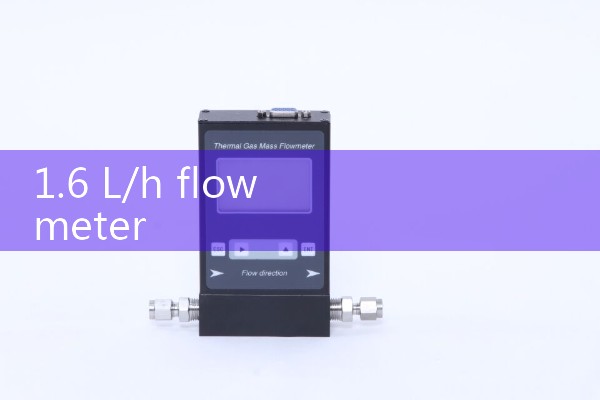
 Hot Product
 Related AD